| Home | Manuscripts | Top-10 Lists | Rarities | Search |
|
The Best of Sherlock Holmes |
www.bestofsherlock.com/rare/dying-detective-1913-booklet.htm
The First Edition of The Dying Detective:
A 1913 Christmas Gift
By Randall Stock, August 11, 2026 (revised)
The first separate American edition of "The Dying Detective" is a real rarity with an unusual origin.
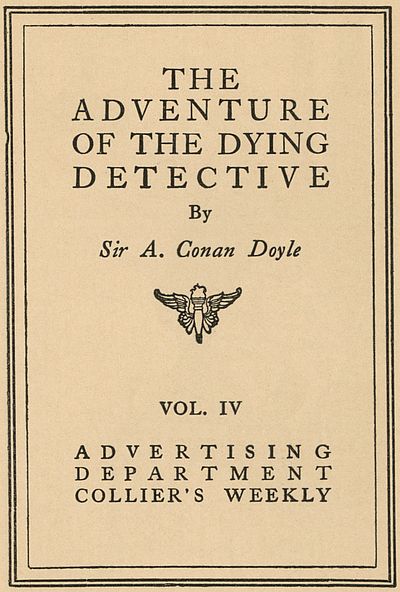
When is a Sherlock Holmes first edition not a first edition? Collectors can argue about English and American editions, or authorized versus pirate copies. Some might debate what constitutes the first American edition of The Sign of [the] Four.
Yet there is also a rather obscure volume produced between the initial magazine appearance of a Holmes short story and its later publication in a collected edition. The original of that rare volume, the first separate American edition of "The Dying Detective," remains beyond the reach of most people. A 2025 facsimile produced in conjunction with the 2025 Baker Street Almanac makes this artifact available to a wider audience.
Holmes in America: Collier's Weekly
In 1903, the American magazine Collier's Weekly famously made Conan Doyle an offer he could not refuse. He resurrected Holmes, initially with an eight-story commitment, then extended it to 12 tales, and eventually finished with a 13-story series. Collier's carried all the stories for The Return of Sherlock Holmes, publishing them from September 1903 to January 1905.
Conan Doyle produced two more Holmes adventures in 1908, and Collier's again published them in America. However, the firm did not obtain the next three Holmes tales. The New York edition of The Strand Magazine carried "The Devil's Foot" and "The Red Circle" in early 1911, while The American Magazine brought out "Lady Frances Carfax" that December.
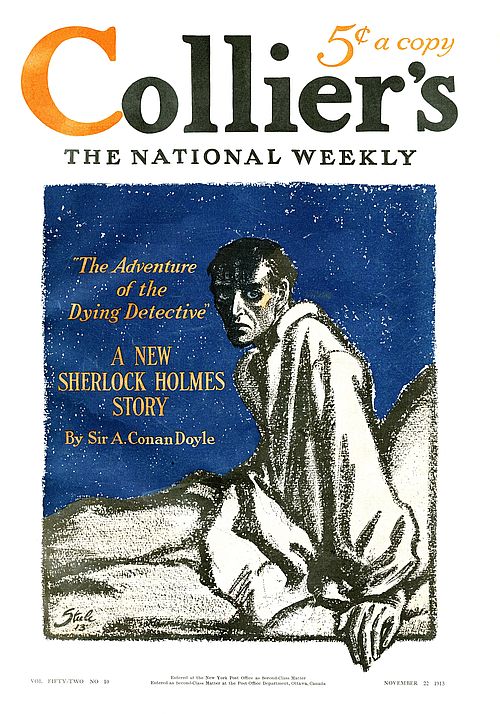
Holmes finally returned to Collier's after a five-year hiatus. Conan Doyle wrote "The Dying Detective" in the summer of 1913. He signed and dated its manuscript on July 27, 1913. The story appeared a few months later in the November 22, 1913 issue of Collier's.
At only 5,800 words, it is one of the shortest tales in the Canon. Yet Collier's managed to extend it across five large pages, in part by including four Frederic Dorr Steele illustrations. The magazine also featured the story on its cover along with a fifth Steele illustration.
Like many Holmes short stories, "The Dying Detective" appeared in American newspapers after its initial magazine publication. The Philadelphia Inquirer, Minneapolis Journal, Chicago Inter-Ocean, Pittsburgh Press, Detroit Free Press, and the New York World all reprinted the story on December 21, 1913. Other newspapers also carried the story, but it is an additional Collier's publication that deserves special attention.
Advertising Pays the Bills
Advertising was an important part of the Collier's business model. The magazine carried more automobile ads from 1903 through 1908 than competitors such as the Saturday Evening Post, Life, McClure's, and Scientific American. Advertisements made up one-third of the issue with "The Dying Detective."
While The Strand Magazine also included advertising, its ads generally appeared at the front and back of an issue. American magazines like Collier's gave greater prominence to their advertisements, and often placed them next to the text of a story or article. That increased the effectiveness of the ads and allowed magazines to charge more for the ad space.
A Collier's reader initially saw three full-page ads before getting to "The Dying Detective." The first three pages of the story did not include any ads. However, Collier's frequently split their main stories and articles, continuing them in the second half of the magazine alongside ads. The text of "The Dying Detective" jumps from page 7 to page 24, and concludes on page 25, with ads on both pages.
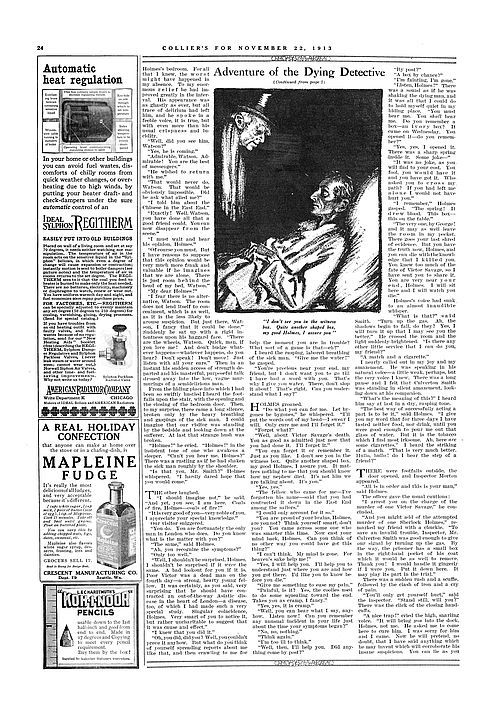
Page 24 with ads and continuation of "The Dying Detective"
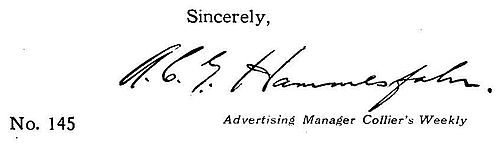
Many Collier's issues included material targeted at potential advertising customers. A long-running series of numbered "bulletins" promoted good practices for businesses, including the use of advertising. Signed by the magazine's advertising manager A.C.G. Hammesfahr, number 145 in the series appeared on page 37 of the issue with "The Dying Detective."
People selling ads often provide business gifts to their customers. At Collier's, the advertising department produced special publications that they probably gave to both existing and potential ad buyers. These special gifts reprinted material from the magazine.
For Christmas 1905, this took the form of a 30-page booklet entitled Mr. Dooley on Timely Topics of the Day. It reprinted three humorous pieces by Finley Peter Dunne from the November 4, November 18, and Christmas issues of Collier's. In 1908, the company produced the 22-page Bridge Whist by George Fitch, "compliments of E.C. Patterson, manager [of the] advertising department." That humorous depiction of bridge whist came from the August 1 issue of the magazine.
While Collier's presumably churned out similar material in other years, most recipients likely disposed of such ephemera. The 1913 publication stands out as probably the most elaborate, and certainly the most collectible, of these promotional items. It included the first separate American edition of "The Dying Detective."
Collier's 1913 Christmas Collection
The 1913 production consists of four bound booklets held in a plain gray cardboard slipcase. That slipcase carries a white paper label on its right side measuring approximately 3.5 x 2.75 inches. The label gives the title of each booklet and credits Collier's. Printed in black ink within a triple-ruled frame, it reads:
Salesmanship. Your House in Order. Editorial Gems. Sherlock Holmes. These booklets containing reprints of articles and editorials from Collier's Weekly are sent to you as a greeting from the Advertising Department. Christmas MCMXIII.
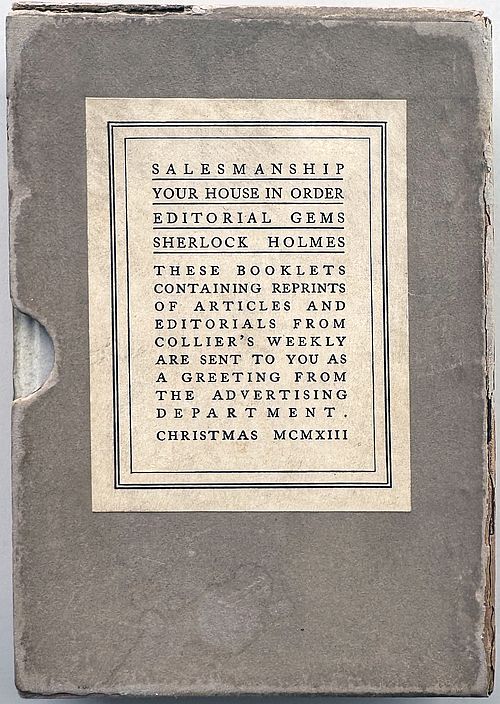
Smaller than mass-market paperbacks, the booklets measure about 5.75 x 4.1 inches. They are bound in gray paper over boards with a vellum spine, although a copy of "Your House in Order" held by Glen Miranker uses tan-colored paper for its cover.
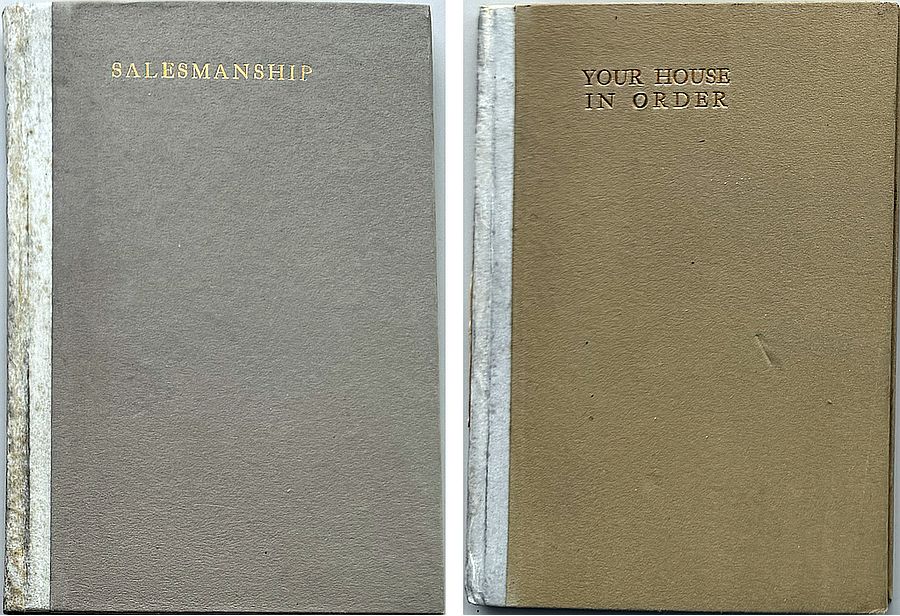
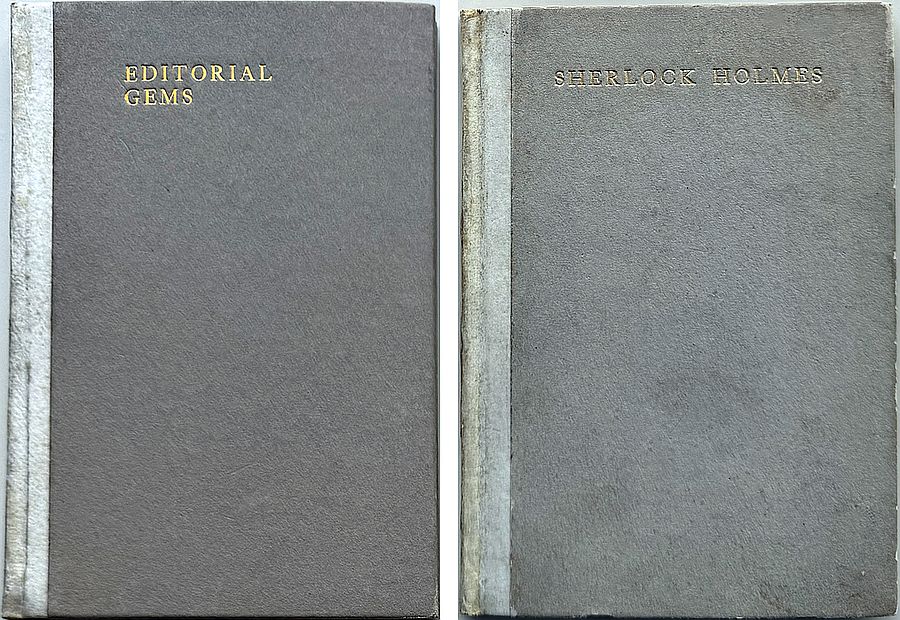
Front covers of booklets in Collier's 1913 Christmas Collection
Each booklet's title appears in gilt on its front cover, and on its spine in black ink on a white label. Spine labels read upwards from the bottom. Cover and spine titles match the titles on the slipcase label.

Spine of "The Dying Detective" booklet
Booklet length ranges from 36 to 45 pages. While the booklets clearly make up a set, including volume numbers on their title pages, their front matter reveals minor style and wording variations. The title page for each booklet identifies the publisher as the "Advertising Department Collier's Weekly," and provides the following information:
Vol. I: Salesmanship: Rule-of-Thumb Science by William Maxwell.
Vol. II: Your House in Order by Peter Clark Macfarlane.
Vol. III: Editorial Gems from Collier's.
Vol. IV: The Adventure of the Dying Detective by Sir A. Conan Doyle.
Each booklet includes a presentation page with similar wording. For Volume I, it reads:
These articles by William Maxwell are reprinted from the July 12 & July 19, 1913, issues of Collier's The National Weekly & are presented to you in this form with the compliments of the Advertising Department. Christmas MCMXIII. P.F. Collier & Son, Inc.
The comparable page in the Holmes volume reads as follows:
The Adventure of the Dying Detective. A New Sherlock Holmes Story by Sir A. Conan Doyle. Reprinted from the November 22, 1913, issue of Collier's The National Weekly is presented to you with the compliments of the Advertising Department. Christmas MCMXIII. P.F. Collier & Son, Inc.
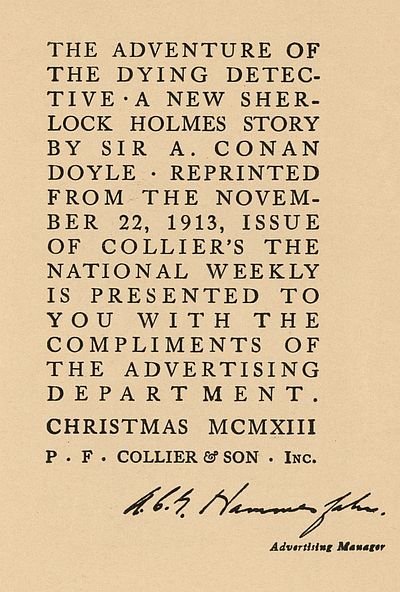
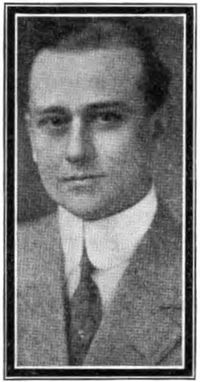
All the presentation pages include the facsimile signature of A.C.G. Hammesfahr, the Collier's Advertising Manager. Hammesfahr started in their advertising department in the early 1900s and became its Western Manager around 1907. The firm promoted him to the overall Advertising Manager position in 1912, and then to General Manager of Collier's in 1916. He resigned from the company in 1919.
Two of the booklets include illustrations. The first volume, Salesmanship, carries one illustration by W.J. Enright from the associated July 12 issue of Collier's. It faces the opening text of the article. The Holmes booklet also contains one illustration facing the story's opening page. See the next section for more about it.
The phrase "with the compliments of the Advertising Department" on each presentation page shows that this set was a gift rather than something sold to the public. The slipcase label mentions "sent to you as a greeting." It suggests they mailed most or all of the sets rather than having a salesperson give them to the recipients personally.
The slipcase label and presentation pages list a general publication date of "Christmas MCMXIII." They also describe the content as "reprints." Given the November 22 magazine date for "The Dying Detective," the firm probably mailed the booklets in early December.
See below for a bibliographic summary.
The Holmes Brand (Dying for Data, Data, Data!)
The cover, spine, running heads, and title page for each of the first three volumes reflect a standard booklet title. Volume 4 takes a different approach. Instead of "The Adventure of the Dying Detective," the cover, spine, and running heads use "Sherlock Holmes."
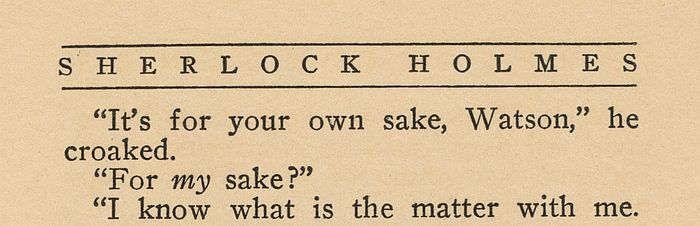
Running head from page 10
This is not purely a length issue. A shortened "The Dying Detective" would fit on the cover and spine, and in the running heads. Instead, Collier's chose to identify the character rather than the story.
This focus on the iconic brand of "Sherlock Holmes" provides a stronger promotional pitch to ad buyers. That would be true for any Holmes story, but it is even more applicable for this tale. Its title has both the general negative connotation of "dying" and a suggestion that it could be the last appearance of Holmes. Neither advances the purpose of getting people to think about placing ads in future issues.
After leading with the Holmes brand on the booklet cover, the firm split the difference on the presentation page by mentioning both Holmes and the story title. The presentation page exactly matches the phrasing on both the magazine's cover and the story's opening page in that issue:
The Adventure of the Dying Detective
A New Sherlock Holmes Story
By Sir A. Conan Doyle.
The Dying Detective 1913 Booklet Illustration
The booklet further emphasized the Holmes brand by including a well-known Frederic Dorr Steele illustration. While Steele provided five illustrations in total for the magazine release of "The Dying Detective," the advertising department did not include any of them in the booklet. Instead, it chose a variation of Steele's 1903 cover for "The Norwood Builder." The firm previously used that cover illustration in 1903 advertising for the series and in volume one of Conan Doyle's Best Books.
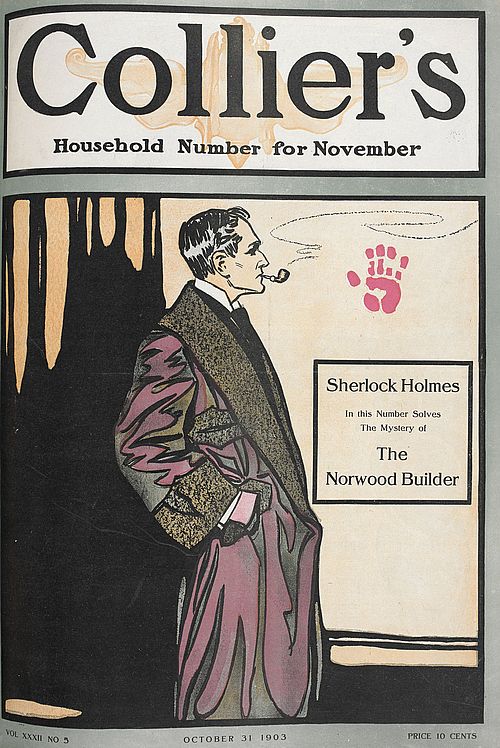
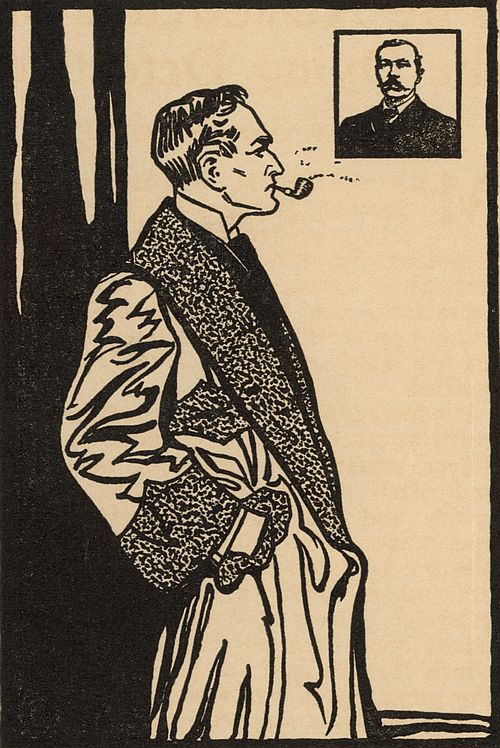
1903 magazine cover and 1913 Dying Detective booklet illustration
The 1903 illustration featured Holmes in his dressing gown looking at a handprint on a wall. This 1913 version replaced the handprint with a small portrait of Conan Doyle. The portrait almost certainly derived from a drawing by "JGS" in Collier's September 12, 1903 issue that was part of a full-page ad for the upcoming "Return of Sherlock Holmes."
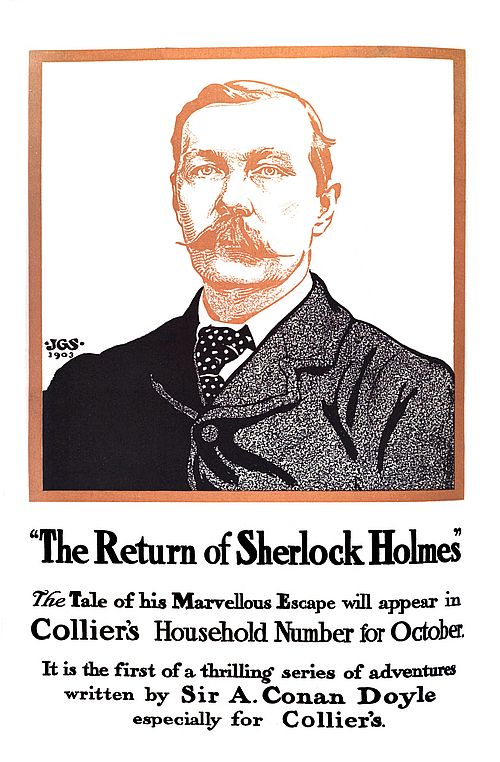
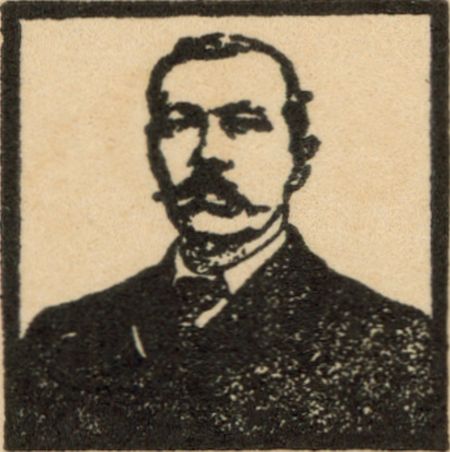
1903 "JGS" advertisement and 1913 Dying Detective booklet ACD portrait
As is common with Holmes stories, the text of "The Dying Detective" varies slightly between the English and American magazines. However, there are no significant textual variations between the story in Collier's Weekly and the version in the advertising department booklet. Compositors either typeset the magazine and the booklet from the same source, or set one from the other.
Bibliographical Notes
For better readability, I standardized capitalization and italics when transcribing labels and text from various booklet pages. The originals could be in all caps or use differing font styles. See the photos above and the 2025 facsimile for the original usage.
Summary Description of 1913 Dying Detective Booklet
5.75 x 4.1 inches. [1-2] blank; [3] Presentation Page; [4] blank; [5] title; [6] illustration by Frederic Dorr Steele with portrait of Conan Doyle; 7-38 text; [39-40] blank.
Gray paper over boards with a vellum spine. Titled in gilt on the front cover as "SHERLOCK HOLMES" and in black ink on a white paper label on the spine as "SHERLOCK HOLMES."
Errata
This paper corrects a few minor errors and omissions about "The Dying Detective" in the revised Green and Gibson Bibliography of A. Conan Doyle (2000). For the first serial appearance in Collier's Weekly, the Bibliography lists only three Steele illustrations instead of the actual four, and does not mention the fifth (magazine cover) illustration. It only cites the Detroit Free Press appearance for the newspaper reprints, and the author's name for Your House in Order is actually spelled "Peter Clark Macfarlane."
2025 Facsimile Version
Ross Davies produced a facsimile version of The Dying Detective booklet in 2025 and included it with copies of the 2025 Baker Street Almanac. The print edition was limited to 221 (unnumbered) copies and was not sold separately.
See a PDF version of the 2025 facsimile (at The Green Bag website).
The printed facsimile is a paperback-style reproduction with virtually the same dimensions as the original. It includes all the printed content of the original plus two essays about the booklet. The extra essays are:
- A Small Case-Book by Ross E. Davies
- The First Edition of ‘The Dying Detective’: A 1913 Christmas Gift by Randall Stock
You can read "A Small Case-Book" at Ross's website starting at page 43 of the PDF version of the 2025 facsimile (at The Green Bag website).
An earlier version of my paper is also in that PDF, but the webpage above has the latest revised and expanded version of my paper.
Like the original booklet, the facsimile has a gray cover with gilt titles and a white strip around the spine. That strip is part of the paperback cover, not vellum like the original. A spine title of "Sherlock Holmes" runs vertically and is printed directly on the spine rather than on a separate paper label. The overall appearance closely resembles the original booklet.
Open Points / Questions
There is always more to discover. If you have information on any of the following points, please contact me. I keep names and contact info private upon request.
When Collier's mailed the 1913 slipcased collection, did they include a cover letter or anything similar with it?
Were all copies of Your House in Order (volume 2) bound in tan as above?
Beyond fading from age, are there other significant color variations for the covers of any of the four 1913 volumes?
Was there any commentary published in 1913 or 1914 about the slipcased collection or the Holmes booklet?
Do you know of any other booklets from the Collier's Advertising Department or given by Collier's as Christmas gifts?
Acknowledgements and Version History
Before this project, I had never even seen a picture of The Dying Detective (1913) booklet. Ross Davies came up with both the idea and the energy to produce a facsimile, and I was honored to contribute to it. As usual, Ross was a delight to work with and incredibly generous.
Thanks also to Glen Miranker and Ross Davies for providing photos of the booklets and answering my numerous questions.
The first version of this paper appeared in a 2025 facsimile of the booklet produced by Ross Davies. The 2025 Baker Street Almanac included a version of that paper with some grayscale photos.
This August 2026 version on my website provides more photos, many in color, and some additional information.
"Education never ends," said Sherlock Holmes in "The Red Circle." If you have any additions, corrections or comments about this paper, please contact me.
More Sherlock Holmes Rarities
This website has information on many Conan Doyle manuscripts, including both Sherlock Holmes and non-Holmes material.
It also has details on other Conan Doyle rarities, including a census of Beeton's Christmas Annual 1887 with the first Sherlock Holmes story, and a census of Sidney Paget original drawings.
While not rare, there are also lists of the each year's best Sherlock Holmes books & DVDs, the best Holmes stories, and the most famous Sherlock Holmes quotes.
Vers. 2.2bx-RN Original work
Copyright ©2026
Randall Stock. All Rights Reserved.